

26 Sept 2016
JASSO exhibitiion
JASSO (jewellery and silversmithing society of Oxford) are holding an exhibition in which I'm participating. Go have a look!


5 Sept 2016
customised cufflinks
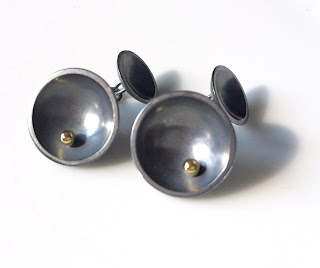
A customer of the New Ashgate Gallery in Farnham liked the look of my cufflinks, but preferred a different type of finding. The usual findings (ie the back) of cufflinks are either:
swivel arm: where the arm swivels to be straight to push through the hole
bar: where there is a set bar and back that do not move
chain: where there is a chain in the middle and some type of back attached to the end of the chain
The cufflinks had the swivel arm finding but the customer wanted a chain finding. So here's the before photo:
And here is the finished product, now with chain and matching back:

swivel arm: where the arm swivels to be straight to push through the hole
bar: where there is a set bar and back that do not move
chain: where there is a chain in the middle and some type of back attached to the end of the chain
The cufflinks had the swivel arm finding but the customer wanted a chain finding. So here's the before photo:
 |


15 Aug 2016
Jewellery Classes past and future
Last week I taught a two day course at the Missenden Abbey Summer School on jewellery making with an emphasis on tube setting. It was a busy two days and we covered a LOT of techniques and did lots of soldering!! Here are some of the results - rings with tube set 3mm CZ:

 Most students also made pendants, although one students made a more complicated ring (unfinished in photo) which will hold two 5mm stones at jaunty angles to the ring shank.
 If you fancy making something like this, more classes coming up in September at Studio E174 in High Wycombe! I also have classes at Chesham and High Wycombe Adult Learning Centres, for more information, see here: http://www.adultlearningbcc.ac.uk/courseList.aspx?SearchCriteria=jewellery&Page=1&contentID=&Orderby=&Direction=&town=&CatID=0&dtFrom=&dtTo=
Start date: 8 September 2016
Finish date:10 November 2016
Thursday 1:30 - 4:00
Number of places: 6
Number of sessions: 5
Start date: 17 November 2016
Finish date:15 December 2016
Thursday 1:30 - 4:00
Number of places: 6
Be guided through a series of projects progressing to designing and making your own individual jewellery.
No experience or artistic skills are necessary. Classes are for both beginners and those with experience.
Classes are small, up to 6 students. Due to small numbers you are guaranteed one-to-one tuition and all
the support you need to translate your ideas into finished pieces.
All our courses provide a range of hand tools and access to equipment. You will be introduced to the
workshop and given full instruction in the use of tools & equipment as the course progresses.Students
can choose to work either in silver or they can work in copper or brass. Silver is not included in the cost.
To book or for more information, please email machidewaard@gmail.com.


Jewellery Making Classes in High Wycombe at Studio E174
Number of sessions: 10Start date: 8 September 2016
Finish date:10 November 2016
Thursday 1:30 - 4:00
Number of places: 6
Number of sessions: 5
Start date: 17 November 2016
Finish date:15 December 2016
Thursday 1:30 - 4:00
Number of places: 6
Be guided through a series of projects progressing to designing and making your own individual jewellery.
No experience or artistic skills are necessary. Classes are for both beginners and those with experience.
Classes are small, up to 6 students. Due to small numbers you are guaranteed one-to-one tuition and all
the support you need to translate your ideas into finished pieces.
All our courses provide a range of hand tools and access to equipment. You will be introduced to the
workshop and given full instruction in the use of tools & equipment as the course progresses.Students
can choose to work either in silver or they can work in copper or brass. Silver is not included in the cost.
To book or for more information, please email machidewaard@gmail.com.
20 Jul 2016
Improved lace imprint hinged bracelet
Years ago, I made a lace imprint hinged bracelet. The fastening was with a little padlock clasp at the front. I was never quite convinced by it, not least because when worn, it tended to snap open a little, so it would be partly open with the padlock holding it together. In short, it just didn't quite work.
For ages, I had this idea to change the clasp to something not only more sturdy, but more in fitting with the design. Since it's lace imprint, I wanted to give it a corset-type look. Last week, I finally had some time to work on it and it turned out rather nice. The clasp works much better and stays firmly shut. There are the three clips on the front and a lip underneath with two dimples that also click the bracelet shut so it's already in place to easily line up the clips. It also looks better because the clasp is not directional - it looks fine when worn. The old version didn't work because the padlock hung in the wrong way if you moved your arm up (so looked best when not on someones arm, which is not the idea!). So, all in all a big improvement.
This is how it was:
 And this is how it is now:
For ages, I had this idea to change the clasp to something not only more sturdy, but more in fitting with the design. Since it's lace imprint, I wanted to give it a corset-type look. Last week, I finally had some time to work on it and it turned out rather nice. The clasp works much better and stays firmly shut. There are the three clips on the front and a lip underneath with two dimples that also click the bracelet shut so it's already in place to easily line up the clips. It also looks better because the clasp is not directional - it looks fine when worn. The old version didn't work because the padlock hung in the wrong way if you moved your arm up (so looked best when not on someones arm, which is not the idea!). So, all in all a big improvement.
This is how it was:

 |
| closed hinged bracelet |
 | |
| slightly open hinged bracelet |
 | |
| top view open hinged bracelet |
6 Jul 2016
Stacking rings commission
A couple of months ago, I met someone at the Henley Arts Trail who had a big birthday coming up and wanted something special to mark that day. She had two stacking rings already - one with moonstone (her husband's birth stone) and one with garnet (her birth stone). She wanted to add to the stack with two more rings - one with another garnet (her son's birth stone) and one with green tourmaline (her other son's birth stone). So first thing was to stretch the existing rings - very carefully - as they were already a bit too tight and adding more rings means you need them to be a bit wider usually. The wider a ring, the larger the size you need. Then I made two ring bands to match the existing ones in size - 1.5mm thick horizontally and 1.4mm thick vertically. The garnet was slightly larger, at 5mm, so I bezel set that one on 1mm sheet with a hole cut out of the bottom. The green tourmaline was 4.5mm, so I tube set that one. And this is how they turned out (with the two new rings on top of the existing ones):
 | |
| two new rings |
 | |
| all rings together |
 | |
| rings in presentation box |
10 Jun 2016
23 June - 21 July Jewellery Classes in High Wycombe
New five-week jewellery classes are starting at Sudio E174. The starting date is 23 June and finishing date is 21 July. Each session is 2.5 hours long and the maximum class size is only 6, so plenty of individual attention! The cost is £115. To join, contact me machidewaard at gmail.com. You can see more details here: www.studio-e174.co.uk
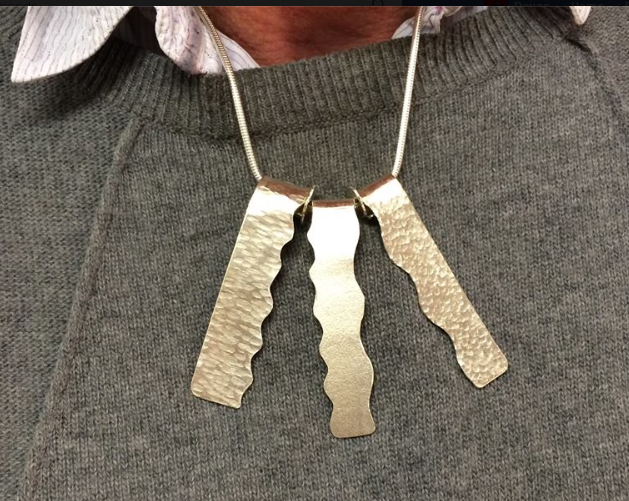
Here are some pieces my students have been working on recently:


23 May 2016
Photographs of jewellery
A while ago I got some more photos taken with a model -- photos by Stone Photos and model is my friend Jane (most photogenic person I know!). Here are just a few of my favourites:


6 Apr 2016
Henley Arts Trail - 30 April to 2 May 2016
Henley Arts Trail is coming end of this month! Come see me at venue 9..... Click on flier for larger view.


4 Apr 2016
Visit to my cousin
What better way to spend Easter weekend than in a workshop? I went to visit my cousin who does woodworking and we spent a lot of time in his lovely workshop. My cousin makes guitars and furniture with the occassional Christmas decoration and a notable project of a ridiculously heavy cutting board commissioned by my husband. (You can read about the cutting board here: https://handguitar.wordpress.com/2015/02/23/a-solid-ebony-chopping-board/) Anyway, so we also made a piece of furniture together: a mini four poster bed for my miniature teddy bears. You can click on all the photos below to see a larger version.
The first thing was to make a plan. We drew out the plan on a piece of wood: (the bed was to be 16cm long, 16cm high and 12cm wide)

 Once we had all the pieces we needed for the frame of the bed, we clamped them together to see if they fitted properly and to decide what we were going to do with the shape.
 My cousin showed me how to saw with various wood saws - quite a bit different than sawing into metal!! You have to take the grain of the wood into consideration and make sure you don't let the saw wander off along the grain instead of along the line you're trying to cut. It was fun to be learning new things! I also got to use a plane, which was also new for me.
 We used chisels, including an old chisel that used to belong to our grandfather. My cousin said our grandfather hadn't been particularly kind to the chisel: used it until it was blunt and then used it to mix paint! Ha! But now the chisel is all cleaned up and sharp again, so we used it to make the dips on the sides of the bed and the curved lines on the bed posts which you can see in this photo.
 Here's my cousin using a large planing machine to get a piece of wood thin enough for our purposes.
 Once we had the sides and posts, we glued thin strips on the inside of the long sides of the bed for the slats of the bed to rest on later. Otherwise there's no place for the mattress to rest on!
 To assemble the bed, we used small brass nails. But because all the wood was quite thin (we didn't want the wood to split), we pre-drilled all the holes and also used wood glue in between all the sections.
 Later, more clamping to make sure the pieces stayed firmly together while the glue dried.
 And two photos of the bed once we finished all the fabricating. Now of course I need to make a mini mattress and bedding!


The first thing was to make a plan. We drew out the plan on a piece of wood: (the bed was to be 16cm long, 16cm high and 12cm wide)

This is a photo of my cousin's bench plus looking through the windows at the other half of the workshop.


 | |
| The bears approve. |
11 Mar 2016
Tube!
One of my students said I should have called my last post "File Files" so I tried to think of a lame pun for tubes, but couldn't think of anything. Anyway! Tube making! I like to make my own tube because I like the process but also because it means I can make exactly the size I want. Of course, you could draw down seamless tube bought from a supplier, but I do just like the feeling of achievement that comes from producing some tube from flat sheet. Also, I get to use one of my favourite tools: the drawbench. Luckily, there is a drawbench at Studio E174 (new classes starting in April!). Here it is: (click on the photo for larger view)
 The drawbench allows you to pull wire and sheet through the drawplate that you wouldn't be able to with just your own strength. If you're only drawing down small wire, you can put your drawplate in a vice and pull it through yourself. You can use regular pliers, you don't have to have draw tongs. The draw tongs do make it easier, as they're made for the purpose! The tongs have a very flat nose so they can butt right up to the drawplate. And they have lots of tiny teeth to grip the wire/tube.
If you're drawing down wire, you are either making it the same shape but a smaller width (for example, 1mm round wire down to 0.5 wire) or you're drawing it into a different profile shape (for example, from round wire to square wire). There are a variety of reasons for doing this - maybe you want to harden your wire, maybe to need smaller wire, maybe you need a bespoke size wire that isn't available from bullion suppliers. The last is especially true for gold, since it's sold in a more limited range of sizes than silver. When it comes to tube, it means you can get exactly the size you want and you can experiment with different profiles as well. Anyway, the drawbench holds the drawplate at one end and holds the tongs along the top and you crank the handle to pull the tongs along and pull your wire/tube through the drawplate.
To make tube, you cut a piece of sheet with a sort of ant-eater nose at one end. Then you start with the largest hole in a drawplate of large size holes and slowly work your way down in size. Lots of annealing is required and the point of your sheet will break off and need to be filed back into a decent point so it can fit through the drawplate. Do not make the sheet too wide to start with, as with this copper example (middle piece), or the sheet will cross over instead of meeting in a seam.
 If you're using a very expensive metal, or you just like being super thrifty, it's best to solder on the nose in copper so you don't lose any silver/gold when the nose breaks off. If you're using pre-made seamless tube that you're drawing down, you can solder a bit of copper wire inside one end and file it into a taper.
Here's the set up with the drawplate at one end, the silver tubing sticking through the drawplate and the tongs gripping the tube.
 Here's a close up:

If you're working with a larger piece or it's all being rather difficult, you can also use a lubricant like wax to help the wire/tube move more smoothly. Drawplates can be bought for a range of budgets. If you're going to be using them lots, then a more expensive one is worth it - the drawing down is smoother, the resulting shape is more consistent and neater. Some cheaper drawplates aren't that well made, so they leave grooves or lines on the finished piece. It depends on what you're doing if that's important or not.
In the first photo, we have the tube as it's coming together, the forming of the seam. In the second photo are the finished bits of tube (which I use for brooch findings). I straightened it just by hand. You can also roll it between two bits of steel to straighten. You can solder your tube seam shut at this point, but as I only use very small pieces at a time, I solder seam down on the piece so it's soldered shut at that point instead.This is obviously not an exhaustive post about tube making - you can read more about tubing by he-of-the-brilliant-name, Charles Lewton-Brain over on Ganoksin here: http://www.ganoksin.com/borisat/nenam/tube-hints.htm


If you're drawing down wire, you are either making it the same shape but a smaller width (for example, 1mm round wire down to 0.5 wire) or you're drawing it into a different profile shape (for example, from round wire to square wire). There are a variety of reasons for doing this - maybe you want to harden your wire, maybe to need smaller wire, maybe you need a bespoke size wire that isn't available from bullion suppliers. The last is especially true for gold, since it's sold in a more limited range of sizes than silver. When it comes to tube, it means you can get exactly the size you want and you can experiment with different profiles as well. Anyway, the drawbench holds the drawplate at one end and holds the tongs along the top and you crank the handle to pull the tongs along and pull your wire/tube through the drawplate.
To make tube, you cut a piece of sheet with a sort of ant-eater nose at one end. Then you start with the largest hole in a drawplate of large size holes and slowly work your way down in size. Lots of annealing is required and the point of your sheet will break off and need to be filed back into a decent point so it can fit through the drawplate. Do not make the sheet too wide to start with, as with this copper example (middle piece), or the sheet will cross over instead of meeting in a seam.

Here's the set up with the drawplate at one end, the silver tubing sticking through the drawplate and the tongs gripping the tube.


If you're working with a larger piece or it's all being rather difficult, you can also use a lubricant like wax to help the wire/tube move more smoothly. Drawplates can be bought for a range of budgets. If you're going to be using them lots, then a more expensive one is worth it - the drawing down is smoother, the resulting shape is more consistent and neater. Some cheaper drawplates aren't that well made, so they leave grooves or lines on the finished piece. It depends on what you're doing if that's important or not.
In the first photo, we have the tube as it's coming together, the forming of the seam. In the second photo are the finished bits of tube (which I use for brooch findings). I straightened it just by hand. You can also roll it between two bits of steel to straighten. You can solder your tube seam shut at this point, but as I only use very small pieces at a time, I solder seam down on the piece so it's soldered shut at that point instead.This is obviously not an exhaustive post about tube making - you can read more about tubing by he-of-the-brilliant-name, Charles Lewton-Brain over on Ganoksin here: http://www.ganoksin.com/borisat/nenam/tube-hints.htm


15 Feb 2016
Cleaning rusty files
One of my students over at Studio E174 discovered recently, after cleaning out her parents' garage, that her father had had quite a thing for files. He had an enormous stash of files in a corner of the garage - huge ones, small ones, one with handles, ones without.....but mostly all quite rusty by the time they were found! Kindly donated to the studio, I set about cleaning them.
So, after careful research (ie lots of Googling), I settled on a method to clean the files. I found a bunch of different approaches online to getting rid of the rust, but most approaches came down to four options:
1. vinegar
2. vinegar with salt added to increase its acidity
3. vinegar with baking soda to make a paste to apply to the files
4. commercial anti-rust products which were mostly on American sites (so I wasn't sure I could get them here in the UK)
After reading lots of blog posts and watching quite a few nerdy tool videos (this one is very interesting, useful information about how to easily remove residue in your files from softer metals: https://www.youtube.com/watch?v=bIZll_eqHY4), I went for the vinegar bath approach. I thought adding salt might make it too acidic and eat at the teeth of the files. I couldn't see how the paste would be strong enough, as I sometimes use that for domestic cleaning and it's pretty mild. And lastly, I didn't want to spend much money, so vinegar sounded cheaper than trying to hunt down commercial rust-removers. Happily, distilled white vinegar from Tesco is 39p for a 568ml bottle.
So, step one was to remove all the handles. Step two was to leave the files overnight in a bath of vinegar. Here they are in their bath:
 Step three was to (with gloves!!) scrub the files with a steel brush (I got mine from Clas Ohlsson for £2.79, I'm sure most DIY shops will have them). By this time, the rust was loose, so some hard scrubbing with the steel brush was all that was required. Helpfully, the vinegar also loosened paint remnants that were on some of the files.
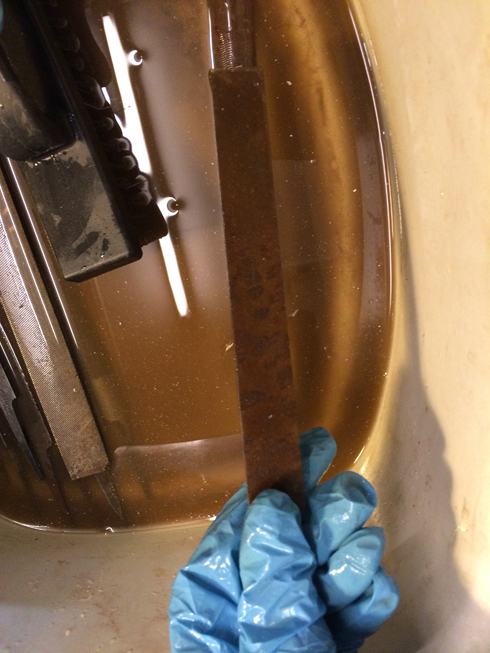
After this, I foolishly left it a bit long before I dried and oiled the files, so in the end I did a second vinegar bath and a second lot of scrubbing. I think it was useful anyway, as some of the files were very rusty, such as this one:
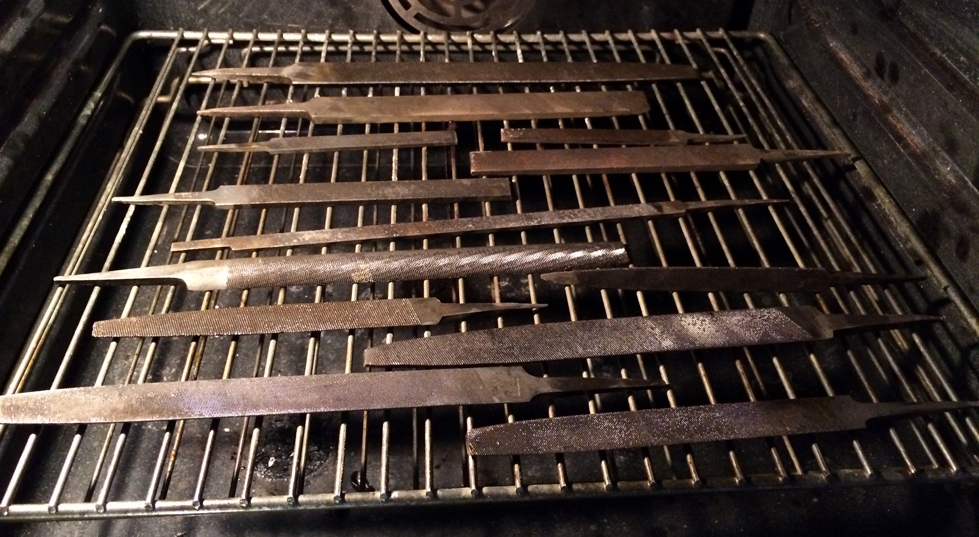
 After the second lot of scrubbing, I dried the files thoroughly by putting them in the oven for 10 minutes at 100C.
 After that, I covered them with a bit of oil. I used this oil:
 And then I put the handles back on the ones that had handles. Now they look pretty good again and certainly usable.

update: I managed to find some more handles, so now they all have handles too!
So, after careful research (ie lots of Googling), I settled on a method to clean the files. I found a bunch of different approaches online to getting rid of the rust, but most approaches came down to four options:
1. vinegar
2. vinegar with salt added to increase its acidity
3. vinegar with baking soda to make a paste to apply to the files
4. commercial anti-rust products which were mostly on American sites (so I wasn't sure I could get them here in the UK)
After reading lots of blog posts and watching quite a few nerdy tool videos (this one is very interesting, useful information about how to easily remove residue in your files from softer metals: https://www.youtube.com/watch?v=bIZll_eqHY4), I went for the vinegar bath approach. I thought adding salt might make it too acidic and eat at the teeth of the files. I couldn't see how the paste would be strong enough, as I sometimes use that for domestic cleaning and it's pretty mild. And lastly, I didn't want to spend much money, so vinegar sounded cheaper than trying to hunt down commercial rust-removers. Happily, distilled white vinegar from Tesco is 39p for a 568ml bottle.
So, step one was to remove all the handles. Step two was to leave the files overnight in a bath of vinegar. Here they are in their bath:

After this, I foolishly left it a bit long before I dried and oiled the files, so in the end I did a second vinegar bath and a second lot of scrubbing. I think it was useful anyway, as some of the files were very rusty, such as this one:


update: I managed to find some more handles, so now they all have handles too!
5 Feb 2016
New class dates announced for Studio E174 in High Wycombe
Jewellery Making Classes in High Wycombe at Studio E174
Thursday 14 April - Thursday 16 June 20161:30pm - 4:00pm
£230 for 10 weeks
Thursday 23 June - Thursday 21 July 2016
1:30pm - 4:00pm
£115 for 5 weeks
Be guided through a series of projects progressing to designing and making your own individual jewellery.
No experience or artistic skills are necessary. Classes are for both beginners and those with experience.
Classes are small, up to 6 students. Due to small numbers you are guaranteed one-to-one tuition and all
the support you need to translate your ideas into finished pieces.
All our courses provide a range of hand tools and access to equipment. You will be introduced to the
workshop and given full instruction in the use of tools & equipment as the course progresses.Students
can choose to work either in silver or they can work in copper or brass. Silver is not included in the cost.
To book or for more information, please email machidewaard@gmail.com.
The studio is located here:
Studio E174
1st Floor, Block B
Commercial Square
Leigh Street
High Wycombe
Bucks HP11 2RH
2 Feb 2016
Missenden Abbey Summer School Course in Jewellery
I'm very happy to say I'll be teaching a two-day course at Missenden Abbey this summer! The course will be silver jewellery with an emphasis on tube setting.
You can click on the picture below for the full details. If you have any specific questions about the course, please feel free to contact me!
Date: 11 - 12 August 2016
Make your own silver jewellery with an emphasis on tube stone setting.
Beginners will be guided through a silver ring project, learning metalwork techniques such as piercing, filing, soldering, sanding, polishing and stone setting as you go. Instruction will be given in the use of tools, including those specific to tube setting. Intermediate students can choose from four set projects (two types of ring and pendant) involving tube setting or create their own design. More experienced students can make their own design or follow the projects and will be shown more advanced tube setting options.
Materials for the set projects will be available to purchase from the tutor (about £7 - £12 per project). Three sizes of tube and corresponding cubic zirconia stone will also be available to purchase from the tutor. If you wish to provide your own materials or have any you feel will benefit the project please feel free to bring them.
To book, call Missenden Abbey on 01296 383582 or visit http://www.missendenabbey-al.co.uk/arca/ for more information.
Click on the picture below for a clearer view:

You can click on the picture below for the full details. If you have any specific questions about the course, please feel free to contact me!
Date: 11 - 12 August 2016
Make your own silver jewellery with an emphasis on tube stone setting.
Beginners will be guided through a silver ring project, learning metalwork techniques such as piercing, filing, soldering, sanding, polishing and stone setting as you go. Instruction will be given in the use of tools, including those specific to tube setting. Intermediate students can choose from four set projects (two types of ring and pendant) involving tube setting or create their own design. More experienced students can make their own design or follow the projects and will be shown more advanced tube setting options.
Materials for the set projects will be available to purchase from the tutor (about £7 - £12 per project). Three sizes of tube and corresponding cubic zirconia stone will also be available to purchase from the tutor. If you wish to provide your own materials or have any you feel will benefit the project please feel free to bring them.
To book, call Missenden Abbey on 01296 383582 or visit http://www.missendenabbey-al.co.uk/arca/ for more information.
Click on the picture below for a clearer view:

4 Jan 2016
Christmas cufflinks
These cufflinks were a Christmas surprise for a certain member of the Reading Male Voice Choir which I made with the RMVC logo set with a type of varnish into silver frames.


30 Nov 2015
Jewellery Classes in High Wycombe
Classes will be starting again at the end of January:
1:30pm - 4:00pm
£230 for 10 weeks
Be guided through a series of projects progressing to designing and making your own individual jewellery.
No experience or artistic skills are necessary. Classes are for both beginners and those with experience.
Classes are small, up to 6 students. Due to small numbers you are guaranteed one-to-one tuition and all
the support you need to translate your ideas into finished pieces.
All our courses provide a range of hand tools and access to equipment. You will be introduced to
the workshop and given full instruction in the use of tools & equipment as the course progresses.
Students can choose to work either in silver or they can work in copper or brass. Silver is not
included in the course cost.
To book or for more information, please email machidewaard@gmail.com
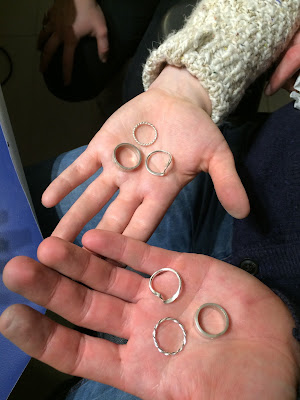
I also offer private lessons at my studio in Reading. Last week I had two students for a day class on how to make silver rings. It was a lovely day and they succesfully finished three silver rings each:
Jewellery Making Classes in High Wycombe at Studio E174
Thursday 28 January - Thursday 31 March 20161:30pm - 4:00pm
£230 for 10 weeks
Be guided through a series of projects progressing to designing and making your own individual jewellery.
No experience or artistic skills are necessary. Classes are for both beginners and those with experience.
Classes are small, up to 6 students. Due to small numbers you are guaranteed one-to-one tuition and all
the support you need to translate your ideas into finished pieces.
All our courses provide a range of hand tools and access to equipment. You will be introduced to
the workshop and given full instruction in the use of tools & equipment as the course progresses.
Students can choose to work either in silver or they can work in copper or brass. Silver is not
included in the course cost.
To book or for more information, please email machidewaard@gmail.com
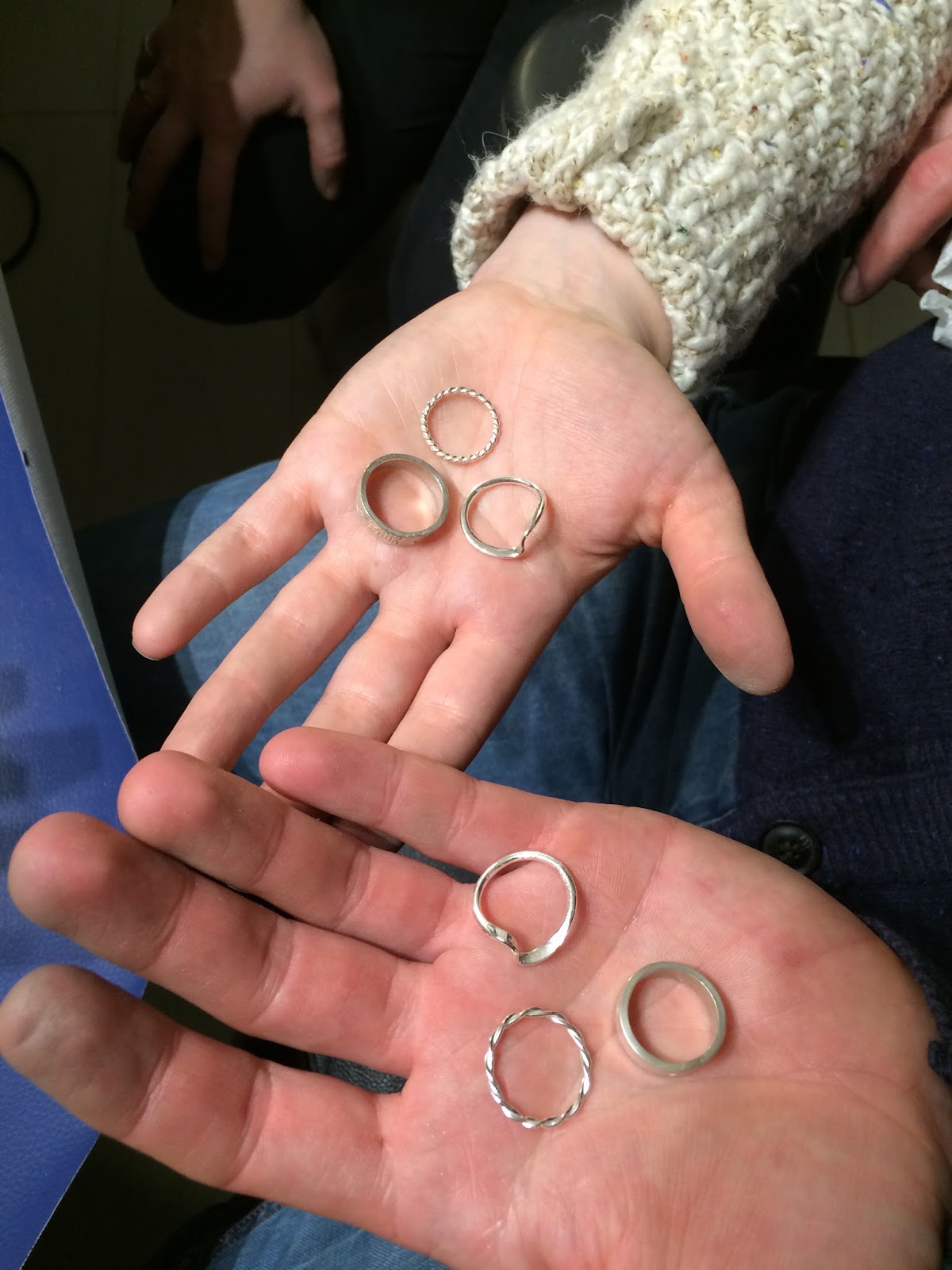
I also offer private lessons at my studio in Reading. Last week I had two students for a day class on how to make silver rings. It was a lovely day and they succesfully finished three silver rings each:
Subscribe to:
Posts (Atom)


